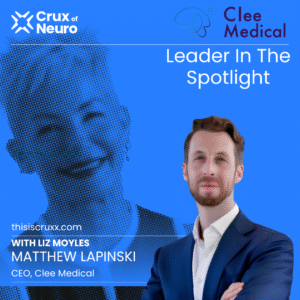
LEADER IN THE NEUROTECH SPOTLIGHT: MATTHEW LAPINSKI, CEO, CLEE MEDICAL
ABOUT LIZ MOYLES – HEAD OF NEUROTECH, CRUXX, AUTHOR
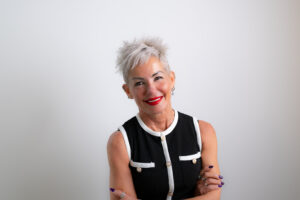
Liz Moyles is a self-described frustrated neurosurgeon. A lengthy hospital stay in her teenage years left her with PTSD and a fear of hospitals and blood, rerouting her career path entirely at 18.
Medicine was the plan. Biochemistry became the reality. But life in a lab was not where she belonged. What never left her was her fascination with the brain and the people building in the space.
Today, as Head of Neurotech at Cruxx, she works with start-ups and scale-ups across the US, Europe and beyond to help them attract the talent and capital required to build.
Her aim is simple: to give CEOs and leadership teams their time back to operate at a strategic level, not get pulled into day-to-day execution.
Fundraising, clinical trials, and regulatory work already stretch teams thin. Hiring sits on top of all of it.
When it goes wrong or moves too slowly, the consequences are immediate. It can mean missing funding, delaying submissions, slipping milestones, or losing people through overload.
Liz leads global executive searches for VCs and neurotech companies, placing C-suite and board-level leaders and building out senior teams across the US, Europe and beyond.
Embedded in the neurotech ecosystem, she speaks regularly with founders, operators, KOLs and investors, giving her a clear view of where the field is heading and what it takes to succeed in a start-up. That perspective shapes how she approaches hiring.
In start-ups, every hire matters, and attracting the best is non-negotiable. But they are rarely looking. Busy building elsewhere and often unaware of what you’re doing.
Finding them is one challenge. Getting them to engage is another.
But while you and your hiring managers are trying to find these people, the clock is running. FDA submissions, fundraising rounds, clinical trials.
Everything that cannot wait is …………waiting.
Reach out to Liz. That person is out there. She knows the space and where to find the people.
They just don’t know you exist. Yet!
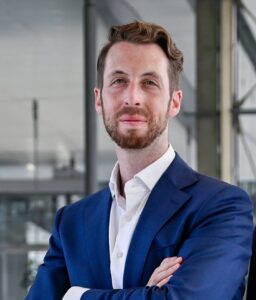
Matthew Lapinski spent over a decade building some of the hardest things in medical devices: Class III implants, the category that keeps engineers up at night, where the FDA holds you to the highest bar and there is no established playbook to follow.
Peripheral stents. Weight loss devices. Intrathecal drug delivery. Each one novel. Each one cleared.
Three of the four startups he worked at in Boston achieved successful exits, including one device that has now been implanted in over 300,000 people worldwide.
He was, by his own description, always engineer number one or close to it, handed a napkin sketch and told to figure it out.
And yet something was pulling him somewhere else. Not toward a specific technology, but toward a specific organ.
The brain, he says, is the final frontier of the body. He says everything else is super cool, super novel, but the brain is so foundational to us as a species. There are still so many unknowns. And that was where Matthew felt he needed to be.
Around 5 years ago, he packed up 15 years of Boston and moved to Geneva, with 2 criteria:
– he wanted to experience life outside the US, and
– he wanted to work on the brain.
What he found at the Wyss Geneva Center for Bio and Neuro Engineering changed the shape of his career.
He arrived as an engineer. He stayed to build a company.
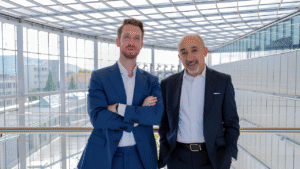
Clee Medical spun out of the Wyss Center’s Minimally Invasive Intracranial Access research project in late 2024, with Matthew as CEO and Dr. Abed Hammoud, a serial inventor and engineer with 30 years of experience leading the transformations in stereotactic surgery, as his co-founder.
Together, they are developing the company’s flagship Neuro Access platform which combines ultra-high-resolution, 300,000 to 550,000 times greater than MRI, and without contrast agents or radiation. It uses real-time intraoperative Optical Coherence Tomography imaging with advanced navigation capabilities to support precision neurosurgery
The problem they are solving is deceptively simple to describe and extraordinarily difficult to solve.
The technology is designed to provide real-time imaging inside the brain, helping surgeons navigate complex anatomy with greater confidence and enabling safer access to deep brain targets for more targeted neurotherapies.
When surgeons operate on the brain, they are navigating from a map drawn before they arrived. The brain shifts once the skull is opened. The coordinates change. The pre-operative MRI no longer reflects reality.
In procedures where millimetres matter, which in neurosurgery is all of them, that gap has consequences. Clee Medical‘s Neuro Access has the potential to close the gap between pre-op and real time.
The company’s backers include the Wyss Geneva, High-Tech Gründerfonds (HTGF), Zürcher Kantonalbank (ZKB), Kickfund, FONGIT, and Venture Kick.
I started by asking Matthew how a mechanical engineer from Boston became a neurotech founder in Geneva.
DEALING WITH THE FDA AT 19 & A NAPKIN
Liz: Lovely to see you again Matthew. Good to hear all is going so well. As always, I like to start by asking, when you were growing up, did you ever imagine you would be working in the field of neuro or the medical world even?
Matthew: Great to see you again too Liz.
When I was young, life was quite easy. Going to school, having fun.
I didn’t really consider the future very much, but life changed when it became time to decide what to study at university. I chose Mechanical Engineering simply because I was good at maths, decent at physics and science.
I was originally really excited by the idea of going to what’s called a Co-Op school, where you go to university for 6-8 months, and then go to a long internship for another 6 months, completing in effect a 12-month window of study and industrial experience.
There are several advanced schools like that in the US and one of those was in Boston, which was perfect. I grew up near New York City, so it was not close enough to home that my parents would show up unannounced, but it was a new city and a vibrant one. I wanted my freedom but to still stay relatively close to the family and my friends.
I was fortunate during my time in the Co-Op school to win a placement at a start-up company developing Superlastic Nitinol for peripheral stenting applications. Class III devices. It was a startup doing design and manufacturing, full cycle, and I was 19 years old.
It was just amazing to go from theory to reality and to see the real-world applications of materials I studied. It was like pieces of the jigsaw coming together for the first time.
Nitinol is an incredible material. You can literally take something the size of my pen, bend it, touch it to itself, let go, and it fully recovers.
That really transformed the way I see the world. As an engineer, you’re going to spend so much of your time working hands on, that I realised that whatever path I chose, it had to be solving problems that make a drastic impact on people’s lives.
I was never interested in incremental. I knew I wanted to be developing technology that is genuinely novel.
Liz: Do you think you would have ended up in healthcare had you not landed in that first placement?
Matthew: Honest answer: I don’t know.
My mother was a dietitian, my brother is a nurse, so healthcare was probably somewhere I’d have explored regardless.
But really, that first placement was incredible.
Being at a startup, I was able to touch and do things I wouldn’t have done in a big, structured organisation. I had direct engagement with the FDA as a 19-year-old co-op.
I didn’t realise at the time how unique that was.
I entered the workforce in Boston, which is a great area for Medical Devices and for startup medical devices, and I had a lot of fun.
Most of the time I was first engineer in, or very close to it. It was always the stage where you pretty much have a napkin taped to a wall and someone says, we raised some money on this idea.
We had no idea how to turn the idea into reality – we just had to go figure it out.
Liz: And it looks like you managed to turn those napkin ideas into successes because I know 3 out of those 4 startups had successful exits. Was anyone particularly special to you?
Matthew: I developed systems for the spine, heart and weight loss.
The one closest to my heart was Allurion Technologies. I joined as employee 9. It was a Class III implantable weight loss device, nothing to do with neuro, but interesting from a Mechanical Engineering and Materials perspective. I had a lot of ownership over the whole project.
And to date, after I left, they’re still using the design I led on, I believe over 300,000 people worldwide have now had that implant. That’s why it’s closest to my heart. Something that is so tangibly benefiting people.
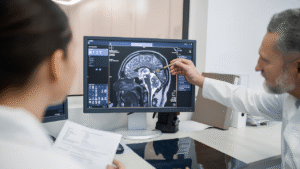
THE BRAIN – THE FINAL FRONTIER
Liz: So you were in Boston, building class III devices, having a brilliant experience. How did you turn from weight loss to the brain and Clee Medical and Geneva?
Matthew: I worked across different startups in the Boston world, and mostly Class III.
What’s interesting about that is you develop skills that are relatively unique. Class III medical devices are not easy. You don’t have a standard to follow, yet the FDA will hold you to the highest bar. You are literally designing something no one’s ever done, running the clinical trials, and so on from scratch.
About 5 years ago, a little over, I decided I wanted to experience life outside the US, and I wanted to work on the brain. Those became my two criteria for finding my next adventure and mission.
Liz: Where did the passion for the brain come into the picture? The things you’d built were heart, weight loss, spine previously,
Matthew: Yes, as you said, by this point I had worked on peripheral stents, weight loss into the gastrointestinal tract, fixation devices, and intrathecal drug delivery through the spine.
I wanted to work in the brain because everything else I was doing was super cool and super novel, but I felt and still do that the brain is the final frontier of the body.
You can find new ways to treat other parts of the body, but the brain is so foundational to us as a species, and it is still so unknown.
Neuroscience is growing at an incredible pace.
BCI and other applications are growing in leaps and bounds. I was really interested in taking some of those hard-won skills from Class III devices and bringing them into the brain.
I was very fortunate to find the Wyss Geneva, a little over 5 years ago. I joined as an engineer, and I kept bouncing between engineering and management.
I really loved being close to the tech and hands on it but then one project really caught my eye and I was hooked.
THE BRILLIANT IDEA BUT NOBODY WANTED IT
Liz: Tell me about that project.
Matthew: The original idea was around a technology to automate neurosurgery for regional care.
If you get into a bicycle accident or a car accident and there are signs of brain haemorrhaging or pressure buildup in the brain, odds are your local hospital can’t treat you as they don’t have the capabilities.
So, the original idea was to develop a way for regional care centres to do basic neurosurgery, open the skull, put pressure sensors inside, start generating data, so they could decide with Specialised Care Centres this person needed to be moved to if any.
I thought it was really interesting.
The project encompassed robotics, automation, neuro, and it was something that had never been done before,
It was about enabling better patient care.
I got started working on this original concept and we developed cool technology.
A fully functional automated prototype which allowed micro-drilling of the skull, using a custom algorithm to make sure we didn’t pierce the meningeal tissue.
We had probes coming down into the brain and used imaging to avoid blood vessels.
It was really exciting from a technology perspective.
And then I started talking to surgeons and potential users, and I found that nobody was interested.
All the non-neurosurgeons we spoke to said “I’m not taking the risk of doing neurosurgery. That’s not something we’re doing.”
And neurosurgeons said, “I don’t need help opening the skull. A smaller hole is interesting, but today the tools are made for larger. If you make me a smaller hole, then I might be interested but this is nothing special.”
Liz: That must have been a bit disappointing, but what did it teach you?
Matthew: It really was. My motivation had and always has been about developing cool healthcare technology that helps people. I realised that doesn’t happen by making just one cool tool that one person is interested in and by sitting in a lab.
Innovations happen by making something that is novel, valuable, scalable, impacts lots of lives and can become a standard of care.
So, I realised I really needed to spend much more time understanding the thought processes, the language, the approaches that the neurosurgeons and neuro-interventionalists had, the workflow, the real-life challenges and situations and current tools before even talking about a problem and how to solve it.
It sounds so obvious, doesn’t it? I was walking around with a solution with no problem.
I spent a couple of hundred hours in neuro operating rooms after that, in Boston, the US South, the West Coast, France, Switzerland, Germany, the UK. I was just being a shadow and trying to understand how these surgeons operated. And I was shocked to learn how little data they have access to despite doing complex surgeries.
And that’s what led to the pivot.
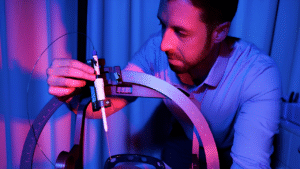
THE PIVOT
WHAT THE BRAIN DOESN’T TELL YOU
Liz: So, you identified a lack of data problem. Walk me through what you’re building and the pivot.
Matthew: The problem is rooted in the lack of data that surgeons and their teams have during neurosurgery.
When someone goes into the brain, they have an idea of where they need to be, how they’re going to get there, and what they’re going to do, but they’re mostly operating on pre-operative imaging that doesn’t match the intraoperative reality.
Among the things that shift the reality is a phenomenon called brain shift.
You image a brain under MRI in a closed state. You don’t perform surgery that way. You must open the skull, open the meningeal tissue, access the brain tissue, and in doing so, the brain will move.
Cerebral spinal fluid can be coming out. Air can be going in. Yet we as a species, as people performing surgery, have no way of measuring or compensating for that movement.
You might go into the brain and go to the perfect spot you planned for, but the spot itself might have moved a few millimetres or a centimetre to the side. That can be catastrophic.
What we’re developing is a new intraoperative imaging modality based on optical coherence tomography, OCT.
Very, very high resolution, real-time imaging right at the point of tissue contact, so surgeons can see, as they’re descending into the brain, what’s ahead of them.
That’s most helpful for detecting blood vessels, sulci, and other structures.
No surgeon intends to go through a blood vessel, but it is the most common surgical complication in neurosurgery because of the dynamic movement of the brain.
Our system also reconstructs the tissue layers we’ve gone through with incredibly high resolution, in real time. We don’t slow down surgery at all. We spent a lot of time on data processing to make it is super-fast.
As a result, what we’ve been able to show is brain layers that you can’t even see on an MRI, or can only infer from one, interoperably and in real time, without any contrast, without any radiation.
This is helping surgeons do what they need to do faster, safer, and with greater confidence.
Liz: Can I ask what this system looks like?
Matthew: We have a cart system that lives in the OR, it’s capital equipment and we have two consumables.
A slender probe with a 3-metre cable that connects back to the cart, and a micro drive that connects into the stereotactic frame. Everything, the cart, the software, the firmware, the probe, the drive, is completely custom. The probe fits naturally into existing surgical equipment. Surgeons don’t need to learn new techniques or a new workflow.
Liz: So, do you make the probes, the data algorithms, everything?
Matthew: We make everything. There are some purchased components, off-the-shelf bearings inside the drive, things like that.
But otherwise, it’s a completely custom solution and we have a quite unique data format that helps us process things quickly but which protects so that even if someone got hold of our raw data, it would be very difficult to action on without the various keys we’ve developed to handle that data flow.
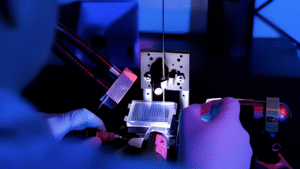
SEEING WHAT NOBODY HAS SEEN
Liz: You mentioned the ex vivo data you’ve generated. What have you been able to show?
Matthew: We have designed to go into the brain during surgery. We don’t have the clearance yet for that, but we’ve been in the O.R. and a surgeon has taken a resected sample and given it to us and within 1 and less than 2 minutes of it leaving the patient, we’ve imaged it.
We’ve shown five different types of brain cancer and each of them showed very different signals from each other, and very different signals from grey matter and white matter.
The most fundamental thing we’ve shown is the grey matter and white matter boundary.
The image is 3- dimensional, and the resolution varies with optical properties of what we’re imaging.
White matter is much more birefringent, it has myelination, it scatters light more. So, we can’t see as far into white matter as into grey matter.
So, we have developed a colour-coding system based on light penetration depth, so it’s less of a training-the-eye exercise for surgeons and much easier for machine learning.
The one type of cancer I find most interesting is the low-grade glioma data. Low-grade glioma typically does not absorb contrast agents. This makes it really difficult to image today on MRI, let alone differentiate from healthy tissue when you’re inside the brain.
But we can see it. We can see the boundary.
No technology exists today that enables surgeons to know what tissue they’re encountering at that level.
Liz: Is this almost like real-time pathology?
Matthew: Pathology is still on a different level of resolution; we’re at around 12 microns, pathology is still more detailed. But data suggests we will be able to do optical biopsy, optical diagnosis.
I don’t see it replacing pathology but what I do see is this- today, it’s relatively common for surgeons to let suspected brain lesions grow bigger so they’re easier to biopsy and hit more accurately, so that if the brain shifts, there’s still enough margin for error.
We believe that with our solution, allowing potential tumours to grow bigger to mitigate risk, will not be the standard of care tomorrow.
You will be able to go in, target precisely, and scope across several areas taking various biopsies from the target location.
In other organs, you never take a single biopsy. In the brain, you do. That’s because we don’t have the technology. This technology enables that.
SPINNING OUT A LIVE COMPANY
Liz: Tell me about the spin-out. How does that work?
Matthew: It was a decently long process.
The Wyss Center does this well. It is a non-profit research organisation developing cool neuro solutions. But they are a research centre. You can come develop tech with less of the pressures that you have as a standalone start-up company. You can make mistakes, to really understand the use cases.
But for all those traits, they’re not made to scale. They’re not made to get a commercial-ready product out the door. So, after we’d done a fair amount of technical de-risking, to the point where we had an investable technology, it made sense to spin out and that is one of the aims of the Wyss Geneva.
This means the Wyss Center could use their funds and focus to develop the next cool thing, while we took what we had to the next level – to build and scale up.
Our office is still part of the Wyss Center space, and we still talk to the team most days. Since we spun out, the Wyss Center has had a couple of other spinouts, including @Rotem Kopel’s @ABILITY Neurotech, which was the longest project in the history of the Centre.
I think they now have a portfolio of around 10 companies, a combination of spinouts and spin-ins.
Liz: What does being part of something like the Wyss Center give founders like you?
Matthew: A lot. The office space and lab equipment is obviously very tangible.
But more than that, as an early-stage company fighting for the attention of investors and clinicians, it comes with recognition and credibility. The Wyss name, going back to Hansjörg Wyss and his history with Synthes, is very well known within medical devices.
And then there’s the network. We have a Wyss CEO WhatsApp group. Just yesterday I asked a question about a nuance of Swiss Law I didn’t know and had another CEO from the network who had just looked into the same issue, and they answered me in minutes.
That’s people I would never have met if it wasn’t for the Wyss Center. It gives you a fraternity you can rely on, a common way of thinking, as well as the access to funding, grants, credibility, contacts.
THE ENGINEER WHO BECAME CEO – DIFFERENT FIRES
Liz: As you said, the transition to being a CEO was made more natural by the way the Wyss Center structured your project. What have you learned about making that move, engineer to CEO, that might be valuable for others considering it?
Matthew: The challenges are very different.
When you’re doing engineering, you learn how long technical things take. I underestimated how long the less technical tasks take.
If you’re going to do it, you need to realise that being a CEO is an incredible amount of work, and that work is different.
The fires you fight are different. The way you apply your creativity and your problem solving are different. But they’re no easier. Just super different.
When I first started, I had the naive belief that I could do engineering one day a week. That was inaccurate. If I tried to do that, the product would suffer and the company would suffer.
You really need to let go of a lot of the technical things and make sure you’re focused on building the company, developing the right strategy, coming up with clean and clear narratives for all the different people you’ll be talking to.
Something else that I’ve heard other engineers find challenging, and fortunately I’m not too burdened by, is the feeling of despondency as you repeatedly hear NO from investors. The same conversation a thousand times, and hearing NO in 999 of them. Or hearing absolutely nothing. Or hearing something that logically doesn’t quite make sense, but you realise it’s just a polite way of saying no.
There’s the saying, you must kiss a thousand frogs. That’s certainly part of it. But it’s also make-versus-buy decisions, conversations with potential collaborators, companies that might lead somewhere five years from now. All of that takes hours to prepare for and have.
Liz: I know that is so hard. How do you keep going in the face of it?
Matthew: You just have to. I’m quite fortunate.
I realised this back in my days of playing football, if I had a bad touch, it didn’t stay with me. The play continues.
I do believe what we’re building here at Clee Medical has incredible potential to transform the way we perform surgery today. If 99 out of 100 conversations lead nowhere, I see that as 1 conversation leading us closer to a product that gets out there and really transforms patient journeys.
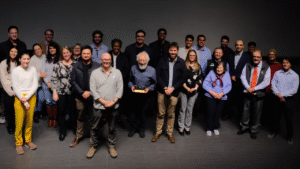
WHAT COMES NEXT
Liz: Where are you now with the funding, and what needs to happen next?
Matthew: We just closed our seed round a couple of months ago, led by High-Tech Gründerfonds, the German VC, joined by Zürcher Kantonalbank, Kickfund, FONGIT, Venture Kick converting earlier grant funding, and with participation from @Wyss Geneva.
We have a bit of runway. We’ll raise a Series A next year.
In the meantime, we’ll do our first-in-human clinical trials, cadaver labs and usability workshops, and develop our QMS.
A couple more things that really need to be done to set the right foundation to scale. We’re in ongoing conversation with regulatory bodies, particularly the FDA, who will be our first market. We’re in Class II through a de novo pathway, which is relatively simplified compared to Class III under PMA.
That Series A fundraise will go towards finishing what we need for FDA approval and initial market release to the US.
Liz: And the device, can it be used with other robots? Is it compatible with other surgical equipment?
Matthew: We’re working to be compatible with the equipment surgeons already use. Whether a surgeon wants to use a robot over a frame, a frame over an alignment system, or an alignment system over a robot. That’s their prerogative. There are different reasons why people choose what they choose. But the unmet need remains the same: surgeons don’t understand well enough what tissue they’re encountering, before and while they’re in contact with it. That’s what we’re solving.
Liz: What’s most exciting to you in neurotech right now, looking beyond Clee Medical?
Matthew: I love neurotech because it is so exciting.
Calling out a specific thing is really challenging. We’re Creative Destruction Lab, CDL Neuro graduates. The CDL accelerator has a neuro stream, and all the other companies there are doing things so differently from us and from each other. It is just awesome to listen to those discussions, see the pitches.
I’ve been happy with my decision to really focus on moving into the brain. There are so many genuinely exciting things going on, and not just incremental improvement. Radically different. It’s very, very exciting.
Liz: What legacy would you like to leave?
Matthew: I’m less concerned about a personal legacy.
The way I define success, and the way I define it to my team, is that whether it’s under a Clee Medical brand or another company’s brand 30 years from now, at any point during the day, our vision technology, along with the machine learning & advanced algorithms we are developing, is being used somewhere in the world.
It’s less the legacy on me as a person or even us as a company. It’s helping the way that we treat patients. As long as that happens, I’m happy.
Liz: Thank you, Matthew, for your time. I really appreciate it and I am excited about the potential of Clee Medical to really make a difference.
I came away from this conversation thinking about a question Matthew raised, almost in passing, that stayed with me.
He’d asked surgeons what size of blood vessel is clinically relevant during brain surgery. And he’d got such a variety of answers that it told him we simply don’t know.
We have been operating blind, in the most literal sense, on the most complex organ in the body. Not through negligence, but through the limits of what we’ve had to see with.
What Clee Medical is building is not just a product. It’s a new kind of data about the brain, the sort of data that will accumulate, train models, and eventually reshape what we understand about brain surgery, neuroanatomy, and perhaps about the brain itself.
Matthew’s goal is that somewhere in the world, at any point in the day, the Clee technology is being used.
More to explore