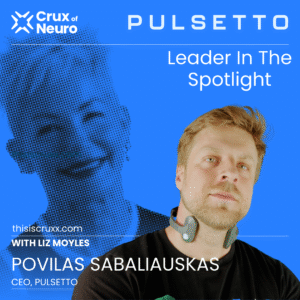
LEADER IN NEUROTECH SPOTLIGHT – POVILAS SABALIAUSKAS, CO-FOUNDER & CEO, PULSETTO
For decades neuromodulation has largely meant implantable therapies delivered in hospitals, deep brain stimulation for Parkinson’s disease, spinal cord stimulation for chronic pain, and vagus nerve stimulation for drug-resistant epilepsy and depression.
These technologies have transformed many lives, but they typically appear late in the care pathway, often after medication has failed.
A new generation of founders is now exploring whether non-invasive neuromodulation could be used earlier, through wearable technologies designed for everyday use.
Pulsetto is one of the companies pursuing that idea.
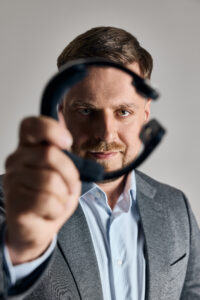
To understand how that journey began, and the realities of building neuromodulation hardware outside traditional medical pathways, I spoke with Povilas Sabaliauskas,
Co-Founder and CEO of Pulsetto.
REACTIVE VERSUS PROACTIVE
Liz: Povilas, great to sit down with you again, although it’s not as warm as when we last met in Malta! For anyone new to Pulsetto, can you start with the simplest explanation: what have you built and who is it for?
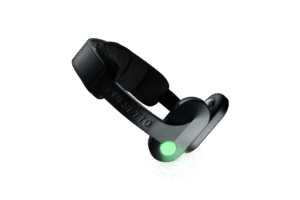
Povilas: Pulsetto is a non-invasive bilateral wearable vagus nerve stimulation device which is designed with the aim of looking good as well as being effective. We have developed a consumer product for daily use. It is a modern slick piece of tech, unobtrusive which you place on your neck. It’s designed for daily use to reduce stress, improve sleep, enhance wellness and generally encourage users to start looking after their mental wellbeing better. We don’t just take the data, we report the data to the user, and we support with suggestions to address the readings for example by suggesting meditation or a walk, and other interventions.
Liz: Can you explain what you mean by bilateral and why that matters?
Povilas: By bilateral, we mean that we are unique in that we stimulate from both sides. We create an electrical field that penetrates deeply enough so that it activates the vagus nerve fibres. These are the fibres responsible for the relaxation state, rest-and-digest. We have three modes as humans, fight, flight or relax/ready state. In our world today, it’s very easy for many of us to get locked into the fight-or-flight state where we are constantly on higher alert. This can lead to stress, higher blood pressure, in the longer term it can become other conditions such as anxiety, depression.
Liz: I don’t think there is a person alive who doesn’t experience stress at some point or other. You pretty much have a global audience. Take us back. How did you enter this space in the first instance, were you always drawn to science?
Povilas: I studied biomechanics and biomechanical engineering in Lithuania and moved into neuromodulation early. I represented implantable systems, vagus nerve stimulation, spinal cord stimulation, and I had exposure to deep brain stimulation.
In smaller countries you don’t specialise narrowly. You travel. I worked across multiple countries in the region, including Lithuania, Estonia, Latvia, Belarus, Kazakhstan and Ukraine.
You stand beside surgeons. You support implantation procedures. You attend the first follow-up visit when stimulation is turned on and titrated.
When deep brain stimulation is activated and tremor reduces in front of you, it does not feel incremental. It feels like you’re watching the nervous system reconfigure itself. It feels like magic.
You realise electricity is not abstract. It is a language the body understands. But you also notice something else.
These devices are used when everything else has failed. When medication hasn’t worked. When the condition is advanced.
And that always stayed with me. Why do we wait until something goes wrong. Why be reactive rather than proactive? We should be monitoring so we can spot trends early on, not wait till the problem has become so severe that the end.
Most neuromodulation is reserved for drug-resistant or severe conditions. But non-invasive neuromodulation could support earlier stages, mild depression, anxiety, chronic stress.
Instead, the pathway is medication first, then therapy, and only later neuromodulation.
There is historical stigma around electricity in the brain. There are economic incentives in pharmacology.
I believe neuromodulation and pharmacology should complement each other rather than compete. But the sequencing today is suboptimal. I feel we are pursuing the wrong route and waiting too long.
Most neuromodulation is used when conditions are severe and drug-resistant.
But non-invasive neuromodulation could be a first line of defence in some cases. Mild depression, anxiety, stress-related conditions. Many people go through medication first and deal with side effects.
THE TESTS WERE NEGATIVE BUT MY FATHER WAS VERY ILL

Liz: You’ve spoken about your father. How did what happened to your father lead to Pulsetto?
Povilas: My father was well one day but then gradually his health declined. We did so many tests. The tests were coming back normal. Everything looked fine on paper. But everyone could see something wasn’t right.
He eventually passed away from an infection, but I never felt that the infection was the real beginning of the story. In my opinion, there was something underlying- perhaps cardiac or pulmonary- that we never fully understood.
That experience stayed with me. It made me question how much we actually detect early. In the medical world, we measure what we can measure but sometimes decline happens outside those measurements. At home. Over time. Slowly. Gradually or even very suddenly.
It also made me question whether tools like neuromodulation could one day be used earlier, before problems reach crisis point.
I’m not saying neuromodulation would have saved him. But I started thinking more about quality of life, about early intervention, about tools that people can use before things become acute. That thinking became part of Pulsetto’s foundation.
We already measure stress markers, blood pressure, heart rate variability. These are indirect signals of autonomic balance.
When the nervous system stays in fight-or-flight for too long, it affects everything, sleep, recovery, inflammation, cardiovascular load.
I’m not saying a wearable device replaces medicine. But I am saying that earlier regulation of stress and autonomic tone could support long-term health in ways we are only beginning to understand.
I was thinking about this and then I met Vitalijus, my business partner. He was already active in the longevity and sleep space in Lithuania, and the problem was also personal for him. His wife had long suffered from severe, sometimes debilitating headaches, and he knew vagus nerve stimulation had been explored as a treatment for cluster headaches.
We both realised that neuromodulation did not have to be reserved for the most severe psychiatric or neurological conditions.
And then we began asking: what if this could be daily? What if it could be preventative?
THREE HUNDRED NO’s
Liz: So how did you go about financing the project?
Povilas: Like all start-up founders, we put our own money in families and friends who believed in us. We developed very basic rudimentary examples of a solution and began trying it out on ourselves and Vitalijus’ wife. It worked. Her headaches dramatically decreased and she also began spotting signs which appeared in advance of a future headache.
She took notes of measurements and started responding to these to try and offset the headaches and she found this also helped. Sometimes it was excessive tiredness, stress, too much caffeine.
We went out to raise external funding. We got 300 rejections and a lot of head shaking, even some laughs.
Liz: How did the rejections make you both feel?
Povilas: It teaches us to detach from rejection. The objections were consistent: hardware is too risky. Lithuania is too risky. The war in Ukraine is too risky. The capital you are asking for is insufficient to be able to make anything meaningful.
One investor finally said: “I will give you €50,000. Build something that looks like a real product.”
That was the test. In nine months, with three people, we built hardware, firmware, software, design, and marketing assets. Not just wires in a box, but something that looked like a product with a website. Everything.
When we showed it to the investor, he said, “Okay. You’ve shown you’re determined and you are crazy enough to build hardware in nine months. I’m going to give you another €450,000. See what you can develop with that.”
Well, that was lot more than what we had ever had, but the truth as everyone knows is hardware burns capital. So, we went to Indiegogo, a crowdfunding site and raised around €250,000 in one month.
For the three of us that was an important and defining moment. We believed in our idea and the investor did. But this was validation. When people contributed, they often shared feedback to say this was what they needed. They confirmed it if was available they would buy it. We were getting our first Voice of The Customer feedback beyond our friends and family.
We began buying components, building supply chain relationships, and developing the devices. We had 3D-printed units. It was very intense, but it was exciting.
COVID arrived in the middle of this which made everything that much more complicated.
Now we were dealing with a worldwide shortage of components and as an insignificant 3-man band, we weren’t at the front of any queues when it came to purchasing power. Prices shot up as we all know and we had to become very strategic and considered about what we would like to change and what we could change within the restrictions we all faced.
We iterated the hardware many times. Assembly, wiring, PCBAs. We went through more than ten refinements. Simultaneously, we rebuilt the application numerous. I think we developed 6 completely different versions in four years before we were happy to go to market.
CONSUMER VS. MEDTECH
Liz: What happened then, were you nervous about how the product would be received?
Povilas: Oh yes. Very nervous. We believed in it, and we now knew others had said they would buy it were it be commercially available, but now- this was the real test. WE did a lot of research about proving points as well as what it would take us to break even and then we went out to the market.
We went to stores in Lithuania, pharmacies, shops where fitness products might be sold and a multitude of ither places as well as our website. We were unknown then – there was no brand awareness, so we could not rely on our website to drive footfalls.
It was amazing. We couldn’t have hoped for anything like it. We were getting approached by brands who wanted to sell our product. It was surreal.
We grew fast in the early years. Three times year-over-year growth. The team expanded significantly. What started with three people became a real organisation. Now it is more stable, there are more than 80 of us but those early years were all about survival.
When you are in survival mode, you focus on shipping and fixing problems. But at some point, the company needs to move beyond survival.
We needed to become intentional.
DATA IS POWER
Liz: What did becoming ‘intentional mean?’
Povilas: We had lots of anecdotal feedback, emails and letters from people telling us the device was helping them with stress reduction, anxiety improvements, better sleep, even road rage.
But feedback is not enough. We needed concrete data.
We began gathering real-world evidence in a structured way. In the application, users can give IRB consent. We began measuring biomarkers like cortisol and cortisone through hair samples. We looked at anxiety scores over weeks, not just days. We integrated with wearables to understand heart rate variability, sleep patterns, recovery.
For several years now, we have been running trials with PTSD patients in the US, including ex-military personnel.
We want to understand not only about immediate relief bit also about the longer term – does anything change and if so, what happens. Is there a trend over time? Is it coincidental? What happens if someone stops using the device.
The long-term goal is not just a wearable device. It is a stress resilience platform.
Consumer isn’t the destination. It was the starting point.
Neuromodulation is usually deployed when everything else has failed. We believe it should be earlier.
MEDICAL DEVICES – THE ULTIMATE DESTINATION
Liz: So what next for Pulsetto?
Povilas: Consumer was never our ultimate destination. It was our starting point. We chose that route first for pragmatic reasons. We need to get a return on investment for our investors – fast.
We are working towards our first medical device. We knew that taking a device through the regulatory pathway takes years and significant capital. It also takes a whole new skill set and very different resources.
Even though this was where we wanted to be, we didn’t have the luxury of time. We had to pay people back and start paying ourselves too!
If you are buying and building hardware devices with limited funding, you either generate revenue or you go down.
Going consumer-first was not a lowering of ambition. It was sequencing. Survive. Prove the concept. Then gather data and with revenue and new investors, pursue MDR and FDA.
As you said at the beginning Liz, stress is universal. Chronic stress compounds -it causes sleep disruption, anxiety, a change in eating patterns, a loss of energy, confidence, concentration and much more. It can lead to burnout and manifest itself in many medical conditions.
Of course, there is a lot we can try to do to help ourselves beyond the pharmaceutical or as well as the pharmaceutical route. People are told to meditate, to breathe, to manage stress. But adherence, especially when people are experiencing stress is difficult.
We saw a huge opportunity in that space and a need for a wearable, non-invasive vagus nerve stimulation device that people could use daily.
NEW YORK, TIMES SQUARE, LONDON – IT’S THE PATIENTS THAT COUNT
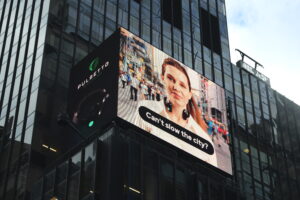
Liz: You’ve had major adverts in Times Square. New York, London, on Netflix. How does that make you feel?
Povilas: The marketing is great. We get lots of media attention, a lot of it unpaid now too. It is driving sales and we feel proud. I am proud of it because our team deserves it. It helps us. It helps a lot.
The first years were very hard. Sometimes it is challenging to keep going in the face of so many obstacles and setbacks. When you are living on belief, determination and hope- sometimes it is challenging, especially when suddenly it’s not just your money but other people’s money. And when you grow from 3 people to 80, you also have the responsibility of paying those individuals. You are looking after them and their families too.
Our employees aren’t numbers. We know every single one of them very well. So, the publicity is reaffirmation for them and us. And as I said it drives sales.
Ultimately though – when it comes to hard days, it is not that, which motivates us or spurs us on. It is the customer stories– their feedback. The fact they feel the device has changed their lives so much that they have taken the time to write to us to tell us.
A man told us he had stopped using sleeping medication altogether after 10 years. A mother from LA who had suffered extreme road rage, wrote in to me to say her children were no longer scared to get in the car with her. There are so many stories, and it is these that matter more than any publicity or billboard.
PTSD / TBI AND VETERANS
Liz: It must be so heartwarming ad rewarding to read those stories. You should be proud of yourselves. Povilas, you mentioned that you have begun some work with PTSD and with veterans. Can you tell me more about that?
Povilas: Yes. Living as we do in Lithuania so near Ukraine, we are very aware of PTSD and also, Traumatic Brain Injuries, (TBI). Stress dysregulation is central in PTSD and TBI.
We believe that our device could also help individuals affected by those conditions.
So, we are in the process of running trials with PTSD patients in the US, including ex-military personnel. As with the consumer population, we want to go beyond any immediate effect, to understanding whether there are any patterns over the shorter and longer -term and whether these are sustained.
We also want to study the impact of cessation. Is there an immediate return of symptoms, is there a sustained period of a lack of symptoms – is this temporary?
This data will help us model habit, retention and long-term impact.
That means better analytics and more layers of data. We integrate with Whoop today. CGM could be another layer. Blood pressure. Possibly EEG.
The more data we have, the better we can understand patterns.
LOOKING TO 2026: WHAT SUCCESS REALLY MEANS
Liz: Let’s look ahead. On 31st December 2026, what would you like Pulsetto to look like?
Povilas: More data-driven. More sustainable. Still growing.
We want to build the best stress resilience tool in wellness and consumer electronics.
We have strong revenue but compared to large consumer companies we are still small. We need to evolve from startup into scale-up.
Brand is what drives the next stage.
We need time and the right people. The company is growing. We need focus.
We want collaborations across hardware and software.
Meditation applications where you can meditate and stimulate at the same time.
EEG and other measurement devices.
Wearables. Platforms.
Partnerships that bring more value to customers.
Reflections:
If neuromodulation can help regulate stress, sleep and emotional resilience, an obvious question follows:
Why do we only deploy these technologies once people are already very ill?
Pulsetto is taking a different route. Start with consumers, build evidence in the real world, generate revenue, and then move toward regulated medical devices.
Whether that pathway proves right or wrong, it is forcing an important conversation about where neuromodulation belongs in the care pathway.
Understanding the brain- the ultimate frontier.
Do You Want to Be Featured?
If you are a CEO or Co-Founder, and would like to be featured within my Leader In The Spotlight NeuroTech, please reach out to me.
Are you a VC, FO, KOL, researcher, or clinician with a specialist interest in NeuroTech, I would also love to feature you.
Thank you – let’s work together to better understand the ultimate frontier – the brain.
About the author

Liz is our Principal Consultant at Cruxx, covering neurotechnology markets. She works globally in the MedTech space, building impactful teams and headhunting unique talent for start-ups pushing the frontiers of medical innovation and technology. From R&D, clinical and regulatory to C-suite and Board level, Liz is exceptional at sourcing visionary, talented individuals for our clients across Europe and the US.
More to explore