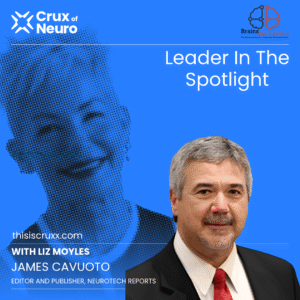
LEADER IN THE NEUROTECH SPOTLIGHT: JAMES CAVUOTO, EDITOR AND PUBLISHER, NEUROTECH REPORTS
ABOUT LIZ MOYLES – HEAD OF NEUROTECH, CRUXX, AUTHOR

Liz Moyles is a self-described frustrated neurosurgeon. A lengthy hospital stay in her teenage years left her with PTSD and a fear of hospitals and blood, rerouting her career path entirely at 18.
Medicine was the plan. Biochemistry became the reality. But life in a lab was not where she belonged. What never left her was her fascination with the brain and the people building in the space.
Today, as Head of Neurotech at Cruxx, she works with start-ups and scale-ups across the US, Europe and beyond to help them attract the talent and capital required to build.
Her aim is simple: to give CEOs and leadership teams their time back to operate at a strategic level, not get pulled into day-to-day execution.
Fundraising, clinical trials, and regulatory work already stretch teams thin. Hiring sits on top of all of it.
When it goes wrong or moves too slowly, the consequences are immediate. It can mean missing funding, delaying submissions, slipping milestones, or losing people through overload.
Liz leads global executive searches for VCs and neurotech companies, placing C-suite and board-level leaders and building out senior teams across the US, Europe and beyond.
Embedded in the neurotech ecosystem, she speaks regularly with founders, operators, KOLs and investors, giving her a clear view of where the field is heading and what it takes to succeed in a start-up. That perspective shapes how she approaches hiring.
In start-ups, every hire matters, and attracting the best is non-negotiable. But they are rarely looking. Busy building elsewhere and often unaware of what you’re doing.
Finding them is one challenge. Getting them to engage is another.
But while you and your hiring managers are trying to find these people, the clock is running. FDA submissions, fundraising rounds, clinical trials.
Everything that cannot wait is …………waiting.
Reach out to Liz. That person is out there. She knows the space and where to find the people.
They just don’t know you exist. Yet!
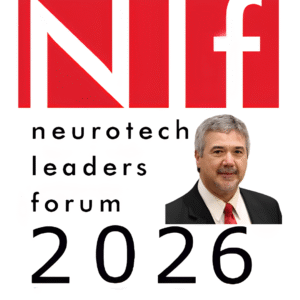
There are people who find neurotech.
And then there are people who built the room that everyone else walked into. James Cavuoto is the latter.
He arrived at it sideways, which is perhaps the only honest way to arrive at anything worth doing.
A Biomedical Engineering graduate from Case Western Reserve University in the late 1970s, he left the field almost immediately because the field itself barely existed.
Neuro-prosthetics, a big interest of his, was new. The jobs weren’t there. So, he went west, took a job at Hughes Aircraft Company, and spent the next two decades writing about lasers, desktop publishing, and the early personal computer industry.
He was in the room when Adobe was founded. He interviewed Michael Dell when Dell was selling computers from a university dorm room.
He launched the first newsletter covering desktop publishing, and then the first digital photography magazine. He sold his publications just before the dot-com crash.
Then, with a 5 year non-compete in hand and nowhere to be, he drove back to Cleveland to visit his old professors.
That visit changed everything. It was, as he puts it himself, his Rip Van Winkle moment.
20 years had passed since he had left neural engineering.
He sat down with his former professor Tom Mortimer, inventor of the first spinal cord stimulation system, and with Hunter Peckham, whose Functional Electrical Stimulation work had by then enabled paralysed patients to stand up out of their wheelchairs using their own muscles.
James was blown away. He wanted to write about it.
In September 2001, a month whose timing he will never forget, he launched Neurotech Reports.
He was, for a long time, the only neurotech journalist in the world. He built a conference series. He wrote books. He found the people whose stories needed telling, and he told them.
25 years on, Neurotech Reports has just been acquired by Cambridge Innovation Institute, and James is preparing to launch a new venture: Brainsconnected.com, a publication and platform dedicated to consumer neurotech.
He is a man who has been early to everything.
Who has watched the world catch up, twice. And who, at the moment most people might consider slowing down, is leaning forward again.
I started by asking him how the story began.

THE BEGINNING
Liz: It’s great to speak with you again James, you are a truly fascinating person and I could talk with you for hours. The things you just drop into a conversation, the people you happen to know, it’s incredible. But let’s start – and it seems sensible to start at the beginning. So, tell me how did your career start. Were you always destined to be in Neurotech?
James: Great to see you again too Liz! Thanks for that comment.
So, to answer your question, it’s funny really. I was a biomedical engineering student at Case Western Reserve. At the time, in the late 1970s, (showing my age here), it was really one of the few institutions with an undergraduate programme in Biomedical Engineering. It was also one of the leading institutions doing work in neuro-prosthetics, when the field was still very new.
I got to meet some of the pioneers. My former professor Tom Mortimer was the inventor of the first spinal cord stimulation system. Hunter Peckham was a postdoctoral researcher at the time and later became one of the pioneers of functional electrical stimulation.
When I graduated, the field was so new that there really weren’t many opportunities for Biomedical Engineers, but I still needed to make a living and stand on my own two feet.
I ended up moving to the West Coast and took a job with Hughes Aircraft Company, you know of Howard Hughes of course, the reclusive billionaire.
Hughes combined a massive inherited fortune with his personal obsession with engineering to revolutionize aviation, and Hughes Aircraft became one of the most innovative and historically significant companies of the 20th century.
As an aside, Liz, he ultimately donated 100% of its shares to the Howard Hughes Medical Institute, (HHMI), not because he was a great philanthropist, but largely as a tax dodge, since he hated paying taxes and despised the IRS.
The IRS eventually forced a breakup of Hughes Aircraft, and its pieces were sold off to companies like what became DIRECTV (now AT&T), General Motors, Boeing, and Raytheon.
As the sole shareholder, HHMI suddenly found itself with billions of dollars and went from being a paper nonprofit that simply granted money to universities, with no real facilities of its own, to building major campuses and becoming one of the largest private funders of biomedical research in the United States.
So, somewhat ironically, a manoeuvre Hughes undertook to avoid taxes ended up having an enormous, long‑term positive impact on medical research, far beyond anything he likely intended. I thought that was funny when I look back.
But anyway, back to your question. That led me into lasers, desktop publishing and eventually the computer industry.
I WANT TO START A NEURO PUBLICATION!
Liz: See what I mean- already what a story and what a life – and you were only starting out!! Needs must. So from Biomedical Engineering to Desktop publishing is quite a dramatic change, but it sounds like you were actually enjoying it. Tell me more about that time.
James: Yes, I did. I spent the next couple of decades building publishing businesses around emerging technologies. Then I got lucky. It could have gone the other way just as easily.
I sold those publications just before the DOT-COM crash. I had a 5 year non-compete agreement, Liz, can you believe that? 5 years, which meant I couldn’t really do anything in the computer industry.
I didn’t want to not work, and I couldn’t afford to not work, so I went back to Cleveland and visited my old professors, Tom Mortimer, Hunter Peckham, a couple of others. I sat down with them and said, “Fill me in. What’s been happening?”
It was like my Rip Van Winkle moment. I had no idea what had been happening in twenty years. And they filled me in. They told me about the advances in neuro-prosthetics, spinal cord stimulation and functional electrical stimulation. I remember thinking, wow, this is exciting.
And I said: wow, this is exciting.
So this is the year 2000, maybe 2001, twenty-five years ago.
And I said: “I want to start a publication focused on this field”.
And they said: we’ll help you.
Liz: And so, you came back to it after two decades away. What happened next and did you meet any people in the early days who affected you and changed how you thought about the field?
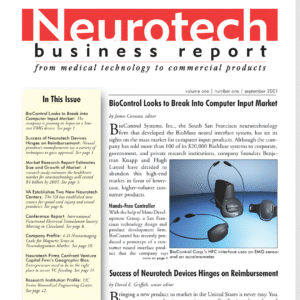
James: Well, we published our first newsletter Liz, and do you know what, I’ll let you have a copy because of you read it, it’s strange. A lot of the things I said I thought would happen in the field, have happened, but I got it wrong. I thought they would have happened a lot faster than they have.
When I launched Neurotech Business Report in September 2001, I wrote in that very first issue that medical applications of neurotechnology were going to be extremely valuable, and I also assumed the computer industry, Apple, IBM, Microsoft and the like, would jump on neurotech quickly and that consumer applications would follow right behind.
I was right about the long‑term potential, but I was wrong on the timing. Consumer neurotech didn’t arrive “right away” at all; it’s taken on the order of 20–25 years for it to really show up in a meaningful way, which is what we’re finally seeing now in 2026.
THE FIRST WOMAN WHO MADE ME CRY – JENNIFER FRENCH
But back to your question, yes. One individual really affected me.
I attended a meeting and heard Jennifer French speak about her experience following a spinal cord injury. She had been an incredibly active young woman, a snowboarder, sailor and pilot. Then, after her injury, she was told she would likely spend the rest of her life in a wheelchair.
But she refused to accept that. Instead, she hunted down clinical trials and eventually became involved with Hunter Peckham’s programme at the Cleveland FES Center.
She received an implant with 8 electrodes and then stood up from her wheelchair using only her paralyzed muscles.
It was incredibly moving. I cried-and not from sadness, but the kind of tears you shed at a wedding: inspiration, hope, and sheer determination.
That experience shifted me from being just an observer to becoming an active collaborator. Jennifer became a writing partner of mine and associate publisher. I had the privilege of editing her life story, On My Feet Again, which chronicles her experience living with a spinal cord injury and participating in a pioneering clinical trial.
I encouraged her to found what became Neurotech Network, which she still runs. It is an advocacy and education organisation helping people understand and access emerging therapies. Over the last 25 years she has become one of the most effective communicators and advocates educator for people with neurological disorders, that our field has ever had.
Her story is a big part of why I committed the next phase of my career to neurotechnology.
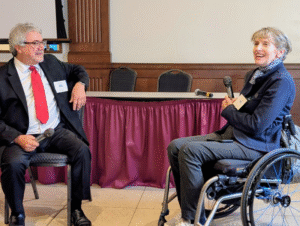
I told the story recently at our Bioelectronic Medicine Forum in New York, Jennifer was there, we did a fireside chat together. I told her she may have been the first woman to make me cry.
THE ONLY JOURNALIST IN THE ROOM
Liz: She is an incredible force of nature Jennifer and such a positive guiding light in the community at the heart of influencing the landscape, regulation, ethics and patient involvement. Amazing that you met her so early in your career.
Tell me, at what point did you decide you wanted to do something even more about everything you were seeing?
James: in the early days attending medical and neuro conferences, I joked that I was the “Founding member of the Neurotech Journalism Society”. At the time there really wasn’t anyone else covering the field. I honestly thought I might be the only neurotech journalist for years.
Liz: If that was the case, did you ever think “am I missing a trick here- is there absolutely nothing here worth reporting? What convinced you there were stories worth telling?”
James: There was a conference at the National Institutes of Health, a neuroplasticity workshop, that I used to attend regularly.
Every year I would come away with incredible stories. What amazed me was that I was always the only journalist there. Not just the only neurotech journalist. The only journalist.
The latest science and technology were being presented directly by the investigators themselves, and nobody seemed to be paying attention. I remember thinking: why aren’t there any other reporters here?
For a long time, we really did have a corner on the market. Today there are many more people covering the field, which is wonderful to see. But we were first.
THINK DIFFERENT – NO ONE EVER GOT FIRED FOR BUYING AN IBM
Liz: Coming back to what you were saying earlier about your predictions in the first newsletter and it taking longer than you thought. Can you explain a bit more about that? Looking back over the last twenty-five years, what are your major observations about how the field has changed?
James: It’s taken longer for both the investment community and the payer community to recognise the potential of neurotechnology. Both eventually got there, which I’m glad to see. It just took longer than I would have liked.
In those early days it was very difficult to raise venture capital. And even when companies did secure funding, commercialising products was incredibly challenging. The road to regulatory approval and reimbursement was excruciating.
We had Frank Fischer from NeuroPace speak at one of our meetings years ago. He described what it was like spending more than a decade navigating the FDA process for their epilepsy device. When they finally received approval, it was a huge milestone.
We also had Skip Cummins, who was CEO of what is now LivaNova.
They became the first company to bring an implanted neurotechnology device to psychiatry through vagus nerve stimulation for depression. Even after gaining regulatory approval, reimbursement remained a battle of denials, appeals and years of waiting.
Liz: I see a big lag also in adoption after commercialisation even if there is reimbursement. Do you think the reluctance from investors and clinicians came or comes from the same place?
James: Investors are conservative. Clinicians are conservative. Clinical societies are conservative. A lot of people don’t want to be the first to step outside established thinking.
It’s still happening now. There’s inertia. It takes time.
A lot of people don’t want to be the first one to go against the grain.
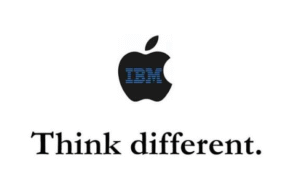
It’s like the old corporate edict: nobody ever got fired for buying IBM.
Apple had a marketing campaign: Think Different.
And we needed and we need more of that thinking from the Venture Capital community, from clinical societies. It’s happening. It’s just taken longer than it should.
FASHIONABLE ELECTRICAL STIMULATION
Liz: In those early years, what did people think would be the hottest parts of MedTech?
James: Cardiology seemed like the obvious model. The technologies are remarkably similar to those in Neuro. Implantable devices. Leads. Power systems. Manufacturing processes. The only real difference is where you’re placing the leads and what you’re treating.
Because Cardiology was so strong a market, we thought it would be a straightforward and easy progression to create an equally strong market in Neuro.
It wasn’t.
Neurotechnology is now a multibillion-dollar industry, but it’s still smaller than many expected given the number of conditions it can address.
The remarkable thing is that whether you’re talking about the brain, peripheral nerves or end organs, it all begins with the nervous system.
Liz: What have you noticed over the years – have attitudes to implanted neurotechnology changed?
James: Ye and quite dramatically.
In the early days there was significant resistance to implanted devices. People were understandably cautious. There was a perception that if a therapy involved surgery or implantation, it must somehow be a last resort.
Christopher Reeve is a good example. I met him in 2004. Like many people living with paralysis, he desperately wanted to see a cure in his lifetime. At that stage, a lot of people believed that cure would come in the form of a drug. Fast forward to 2026 and we still don’t have that pill to cure paralysis.
But what we do have are a growing number of neurotechnology therapies that restore function and improve quality of life.
Christopher himself eventually became the first recipient of a phrenic nerve stimulation system developed by former professor Tom Mortimer, which allowed him to come off a ventilator.
And Christopher as we know became, later in life, an advocate for implanted devices.
It wasn’t a cure, but it was a treatment- and it made a meaningful difference.
Over time I think attitudes have become much more pragmatic. People have seen what these technologies can achieve.
I remember thinking at the time all those years ago, about the irony of it all. I even wrote an editorial joking that perhaps we should redefine FES as “Fashionable Electrical Stimulation” and then everyone would want i !!!
If people were willing to put devices in their ears and elsewhere for cosmetic or lifestyle reasons, perhaps implanted neurotechnology simply needed better marketing.
I remember editorialising in an early piece about the irony, given how many people were
WEARABLES STILL NEEDS A KILLER UBER-LIKE APP
Liz: Clever thinking there James! Beyond treating disease, people are beginning to talk about using neurotechnology to enhance performance. What do you make of that?
James: Elon Musk believes everyone will eventually want a brain implant whether they have a neurological condition or not. The FDA is still going to have something to say about that.
I’m not convinced we’re all heading towards implanted brain interfaces, from a regulatory standpoint or even from a market acceptance standpoint.
But wearables? Absolutely.
Something you can wear and take off, something that can interact with your brain, nervous system, neuromuscular system, sure.
There are already people asking: where do you draw the line?
If someone can’t process numbers, is that a condition, or is it just who they are? Where does treatment end and enhancement begin?
I don’t know, Liz. How good are you at processing numbers?
Liz: Funny you should ask James. Not great. My mind jut goes into a tailspin with numbers.
James: So, is that a condition? Is that something you might like help with, for enhancement? would that be so bad? Where do we cross the line?
I do think we’re entering a period where people become increasingly comfortable interacting with technology that monitors or influences aspects of brain function.
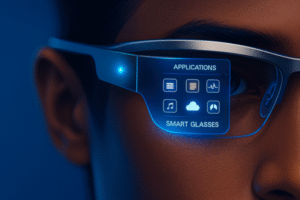
Wearables are a different story altogether. Devices you can put on and take off. Devices that interact with the nervous system without requiring surgery. I think there’s tremendous potential there.
That’s one of the reasons I’m so interested in consumer neurotechnology today.
Liz: What do you think still needs to happen before consumer neurotechnology becomes mainstream?
James: I think we’re still waiting for the killer app.
I don’t know exactly what it’s going to be, but I know it isn’t here yet and I know it’s coming.
When personal computers first appeared, they were interesting machines, but it wasn’t until applications like VisiCalc emerged that people suddenly had a compelling reason to own one.
VisiCalc let you take what you used to write on graph paper, rows, columns, grids, and put it on a computer. It would do the maths, and it would make all the changes without you needing to start over. It was a game changer.
The same thing happened with smartphones. At some point they moved from being interesting devices to something people felt they genuinely needed.
When @Steve Jobs introduced the iPhone, I’m sure he had no idea what the killer app would be. But for me, it’s Uber. If the iPhone did nothing other than run Uber, everyone would want one. You get a ride, you can see where they are, you get from here to there. That’s what we’re looking for, the app that would, almost by itself, motivate millions of people to go out and buy a consumer neurotech device.
Consumer neurotechnology hasn’t reached that moment yet.
Could it be language learning? Cognitive performance? Gaming? Wellness? Something nobody has imagined yet?
If you could buy a wetware product that works with a headset and helps you learn a new language in two days rather than two months , I would buy it. Could it be athletic performance? There’s something neurological in the way Roger Federer or Wayne Gretzky sees the ball, processes it, responds. It isn’t muscles. What if you could begin to emulate some of that?
There’s a company in Switzerland, magnes AG that presented at our conference last year, sensors and actuators built into shoes, using them to treat symptoms of Parkinson’s. But I think there are consumer opportunities there too.
I’m a white guy who can’t dance to save his life. Wouldn’t it be something if an app in your shoes could help with that.
Whatever it is, there will eventually be an application that motivates millions of people to engage with the technology.
That’s when things become interesting.
CAMBRIDGE INNOVATION & NEUROTECH REPORTS
Liz: Neurotech Reports has recently been acquired by Cambridge Innovation Institute. How does that feel?
James: It feels positive. We’re now part of a much larger organisation with capabilities we simply didn’t have before. We understand the field. We know how to create publications, conferences and communities. But there are all sorts of operational functions that become easier with scale.
Sales. Marketing. Production. Event management. Cambridge brings all of that.
Liz: What changes now?
James: Not as much as people might think.
All three of us have agreed to stay on, Jo Jo Platt, Jeremy Koff and I and we’ll continue producing Neurotech Reports, the Neurotech Leaders Forum in San Francisco in autumn, the European Neurotech Leaders Forum in Belgium in June, the Bioelectronic Medicine Forum and everything else we’ve built over the years.
The difference is that we’ll now have greater resources behind us.
Heck Liz, I’m no spring chicken. The timing felt right, and this certainly wasn’t a fire sale.
BRAINSCONNECTED.COM – WETWARE & A NEW ADVENTURE FOR JAMES!
Liz: Tell me about Brains Connected. You mentioned it to me when we spoke last week. What is it.
James: Twenty-five years ago, in the very first issue of Neurotech Business Report, I wrote that neurotechnology would eventually become important to companies like Apple, IBM and Microsoft.
At the time that probably sounded unrealistic.
Maybe I was wrong.
Or maybe I was simply early.
Because today we’re finally beginning to see consumer neurotechnology emerge in a meaningful way.
Years ago, I filed a patent application and was granted a patent related to device-independent and resolution-independent sharing of brainwave data in real time. I kind of stole that concept from PostScript and applied it to EEG signals.
PostScript, Adobe’s technology that allowed different devices to communicate effectively regardless of manufacturer. It was the glue that tied computers to laser printers and scanners and monitors. Even though they’d be from different vendors, different manufacturers, different resolutions, they could still communicate and share data. That’s what put Adobe on the map.
What interests me is interoperability.
Today we have companies developing EEG-enabled , built in headsets, or built in earbuds and a growing range of neurotechnology-enabled consumer products – companies like Earable, emotiv, pulsetto.
What happens when these devices can communicate with one another and share brainwave data in a controlled environment, with specific applications- what we call wetware. Software that interfaces between your brain and your body.
What happens when entirely new applications become possible because information can move between systems?
Those are the questions that fascinate me. And that’s where we want to be.
Brains Connected is my new baby. Brains Connected is my attempt to focus on that future.
It will be an independent spin‑off focused entirely on the emerging consumer neurotechnology space
This project will cover the consumer neurotechnology industry, but it’s also intended to become a meeting place, a sandbox where developers, entrepreneurs and innovators can explore what’s possible.
As I said, Neurotech Reports, has been sold to Cambridge Innovation Institute and will continue to run on the medical and B2B side.
BrainsConnected will cover consumer neurotech products and applications and help foster what I call “wetware” – software that interfaces your brain and body with devices like EEG headsets, AR headsets, and TDCS systems.
The idea is not just to publish articles, but to create a meeting place and sandbox where developers can test ideas, protocols, and interoperability as this rich ecosystem of devices and apps grows.
I’ll serve initially as CEO and editor, my old colleague Mike Adelhart, formerly the first editor of PC Magazine and lately a managing partner at Joyance Partners, will be our chairman, and Jeremy Koff and Sharina Rice will also be part of the core team.
We haven’t formally launched it publicly yet, but we will be doing that soon. I guess this is probably our launch now that I am telling you Liz!!!
Liz: I can see your excitement clearly when you talk about it.
James: I am excited. I have a vision.
I think we’re going to see an incredibly rich ecosystem of consumer neurotechnology devices, applications and protocols emerge over the coming years.
Maybe it takes another 25 years.
I don’t think it will.
I think it’s much closer than most people realise.

CLOSING REFLECTION
As our conversation came to an end, what struck me most was not a particular technology, company or clinical breakthrough.
It was a pattern.
James Cavuoto has spent much of his career arriving early.
Early to desktop publishing. Early to digital media. Early to neurotechnology journalism. And now, perhaps, early once again to consumer neurotechnology.
25 years ago, when he launched Neurotech Business Report, there were very few people paying attention to the field. He was the only journalist in the room.
Today neurotechnology is a global industry attracting billions of dollars in investment and transforming the treatment of conditions ranging from epilepsy and chronic pain to depression, ALS, cancer, Rheumatoid Arthritis, Tinnitus and paralysis.
Yet listening to James, you get the sense he still views the industry as being in its early chapters.
The technologies have evolved. The companies have changed. The market has matured.
What remains unchanged is the curiosity that brought him back to Cleveland more than two decades ago and prompted a simple question:
“What’s been happening?”
The answer became a publication, a community and a career.
And if James is right, the next chapter with brainsconnected.com may be even bigger than the first.
More to explore