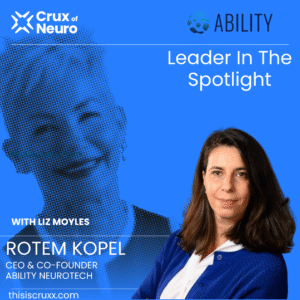
LEADER IN THE NEUROTECH SPOTLIGHT – ROTEM KOPEL, CO-FOUNDER & CEO ABILITY NEUROTECH
The gap in brain-computer interfaces, (BCIs), is no longer imagination.
It is execution.
Not whether we can decode signals, but whether those systems can hold up in the lives of patients who depend on them.
Rotem Kopel, Co-founder and CEO of Ability Neurotech, has built her career in that gap.
Trained as an electrical engineer before moving into neuroscience, her early work focused on building systems that must work reliably at scale. At a certain point, she realised something was missing. The technology worked, but the connection to human impact wasn’t there. That shift led her into neurotechnology, where engineering precision meets clinical reality.
Her path since has spanned neuromonitoring development, investment and technology evaluation, and the often-underestimated challenge of translating research into companies.
Ability Neurotech, a Wyss Center spinout, is building a minimally invasive brain computer interface designed to restore communication and speech for people living with severe loss of function.
She is clear that a “spinout” is not a transition, but a complete rebuild, one that demands new structures, new thinking, and commits long-term real accountability to patients.
At Ability, she is working at the centre of one of the field’s core tensions: how to deliver high-quality neural data without increasing invasiveness to a point that limits real-world use. She frames BCI not simply as a device, but as a communication system, a bridge between intention in the brain and expression in the world.
What stands out most is how closely this work is shaped by patient reality, particularly the need for independence, privacy, and the ability to participate in life on one’s own terms.
This conversation explores how those trade-offs are made in practice, what defines clinical viability in neurotechnology, and what it takes to build systems that work not just in the lab, but in the lives of patients.
I hope you enjoy this as much as I did.
SOMETHING WAS MISSING
Liz: Rotem, how did you end up where you are today? When you were running around the sports field at school, did you think, I want to be in the medical device world?
Rotem: Ha ha. Not at all. No. This was never a planned career. It just happened. Serendipity.
My career began as an electrical engineer. I did my BSc and MSc in Electrical Engineering at Tel Aviv University, and my first role was in telecommunications.
I worked on communication systems and chip design, including at Texas Instruments, and for years I built deep technical capability in signal processing, hardware, and learned the discipline of building systems that must work reliably.
But at a point, although I was enjoying my work, I felt something was missing.
I was missing a personal connection to what I was building- it didn’t feel like a significant contribution. I wanted to do something with more impact on a human level.
I debated whether I should go to medical school or take what I already had and combine it with something new.
I looked around and found a PhD bridging Electrical Engineering and Neuroscience at EPFL.
Neuroscience is multidisciplinary, and people come into it through many routes. For me, electrical engineering connects naturally through methods, devices, and signal processing.
Almost overnight, I was gripped. Biology and neuroscience became a big all-consuming passion of mine and even when I wasn’t studying, I was reading everything I could get my hands on and speaking to anyone and everyone I could find.
Everything was fascinating.
Liz: So, after your PhD what did you do to address this hunger?
Rotem: After my doctorate, I returned to industry but in the medical device space working in technical roles in companies in Europe.
I became curious about what it takes to translate medical device technology into real-world production.
I thought a great way to learn was to move and look at investing. I joined an investment banking firm as a partner specializing in deep tech at Cukierman Life Science & Co.
In this role, I was exposed to the trends and opportunities of the sectors, many interesting technologies and strategies, examined various roadmaps to commercialisation from the idea to the end, and experienced first-hand many types of investment deals.
It was truly amazing and I was fascinated by the ingenuity and talent in the space.
As part of my role I was working with companies, helped them refine their strategies, approach strategic collaborations, what outcomes were realistic, and what the right commercial path could be.
One of the projects that came across my desk was from the Wyss Center in Geneva. It was the ABILITY BCI project.
I spent time assessing the potential, road showing the opportunity with investors, checking out competitors, and potential collaborators. That allowed me to gain a more holistic and more rounded view on the project developed inside a translational research center.
I began getting very involved with the project, the team and the technology development.
Having both inside and outside perspectives gave me strong conviction about the potential.
SPOTTING ABILITY
Liz: That does sound like fate. To move from electrical engineering, to neuro, to Cukierman and then finding this project. Before we talk about ABILITY, can you tell me a bit about the Wyss Center and what it does?
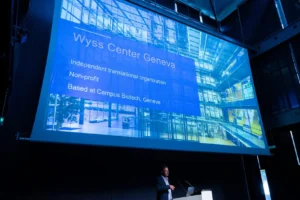
Rotem: The Wyss Center in Geneva is a translational Neuroscience Center.
It sits in the middle of academia and research that is too complex or too advanced for basic science alone, but too early for a company to take on without an enormous risk of never converging.
In that space, you don’t have the pressure of a startup, BUT you are also not in an open-ended research box that never becomes a product. You must be accountable and answerable. The goal is to take a concept to the edge.
Some of the most exceptional talents in neuroscience work out of the Wyss Center. The projects and teams are simply audacious.
The ABILITY project had been borne out of a concept and grew over the space of 8 years to have the legs to move into a company setting.
I was there as it was reaching the maturity point where it had been mostly technologically derisked and moving to clinical readiness.
This is the natural handoff point for the Wyss Center.
The technology was deemed ready to move from a research environment into a commercial entity. The question came up as to who in the team would or could take on the leadership role.
Liz: I’m intrigued. Can you tell me what you mean or what the Wyss Center mean by “derisked?”
Rotem: Yes. There is a moment in medical devices where you must freeze the design. You can develop many iterations, and you do, but at a point you need to identify a first indication if you want to move into humans. That’s when you need to say, “this is our design”.
Then you enter verification and validation, V&V. It is intensive and rigorous. You test everything and more to secure safety, not even efficacy first. It is extensive, it took more than 18 months and is very costly.
That freeze moment is a maturity signal. It means “you are ready to be responsible for what you built.”
SPINNING OUT A PRECIOUS DIAMOND……….
Liz: So, we were saying the team at the Wyss Centre needed a leader for the mission. What happened?
Rotem: The Research lead at The Wyss Center suggested I could be the right person for the role, and I was asked if I would “spin it out”.
Everything I had done to date, my role at Cukierman in an investment banking firm, my different study areas, the work on electronic R&D, passions and interest had all converged into this, the one perfect role for me: engineering, signal processing, hardware, business, financials, fundraising, and collaboration in a community.
Sometimes life gives you an opportunity that simply makes sense.
Liz: You really were in the right place at the right time. Tell me about “spinning out” the Ability project.
Rotem: I think the word ‘spinout’ is vastly under-estimated. The term is bandied around but it’s actually a very significant undertaking.
A “spinout” is a complete rebuild.
When people say, “we spun it out”, it sounds like a single step.
But you are completely changing the DNA of the team.
When a project sits inside a nonprofit, it has a very specific flavour, and it serves the purpose of that environment. When you take it out into the world as a company, you must rebuild from the ground up to fit your new environment. You need to add layers.
You suddenly need close management and governance. You need a full C-level.
You have to stop thinking like a project and start thinking like a company: strategy, how you operate, how you make decisions, how you fundraise, how you communicate, how you plan for a long path, how you govern, and how you are governed. You need an advisory board and much more.
And it needs to:
Make sense financially for its own survival and to attract investors.
Be a company that will exist and grow and survive for the long term to be able to justify the trust of patients and be in a position where you can and will accept the responsibility for patients.
I liken it to the metaphor of a precious diamond.
When you spin out, you do not want to change the material because it is good. But you must fit it into a new environment. It needs polishing, positioning into the right setting. It needs the layers.
Liz: I have often heard the term but never questioned it. So, as you ‘spun it out’, what surprised you most?
Rotem: I think it was the realisation that a non-profit could have developed such a mature technology, almost a product.
Non-profits do not think like commercial entities, and neither should they. It would not do them any service to do so.
But when you become a commercial company, you need to create the scaffolding to enable a technology to become a product and a business; to move from a project to a commercial application.
Looking at ABILITY when spinning out, it was an ‘almost ready’ product. We could start adding all those layers right away.
It may mean the “people on the bus”, (as you say Liz), need to change how they think and adapt to this new world.
The reality is change is always a process, so as a leader it is very much a case of working with;
The people on the bus
To make sure they are the right people
In the right seat
On the right bus
Heading to a new destination.
That meant I had to work with the team and with individuals to agree the new destination, and why that mattered and how we would get there.
It was about building an identity, and aligning the technology to a strategy and most of all it was and is about VALUES.
What do we stand for, why, what is so important and who is important. What are our non-negotiables, what is our North Star. All these things are fundamental to spinning out.
A BRIDGE TO ABILITY
Liz: Let’s talk about BCIs. What do we mean by a BCI?
Rotem: There is a lot of coverage about BCIs.
Companies working with BCIs are all coming at the same goal from different perspectives, but essentially underneath it, we are each trying to build a bridge from edge to edge to restore connection.
Every company in this space is building a bridge, but that bridge is different for every company, different characteristics, different routes, different aims / endpoints, and each has different constraints.
Essentially, BCIs are communication systems. They create real-time dialogue with neural activity.
We are simply connecting parts of a patient’s brain that has lost certain capacities to an external system to help strengthen the signal which remains and amplify & compensate for the weaknesses in the signal.
It is a way to create a channel between intention in the brain and an external output, whether that is speech, text, device control, or other forms of interaction.
That framing matters because it is not only about one device configuration.
It is about what the system enables over time.
It may start off as invasive in the populations where the benefit outweighs the risk for that patient, but as the field evolves, you can imagine the less invasive approaches becoming more prolific for broader use cases.
Definitions matter less than what the system does for people and how it changes their lives.
For ABILITY, two things are central to our differentiation.
First: We have elected to be less invasive and use surface electrodes. We do not want to penetrate the brain. We are invasive in the sense that it is an implant, but we are less invasive than intracortical recording, and we are not putting electrodes into the brain’s tissue.
Second: We capture all the raw data from the brain. We record everything and we transmit everything and discard nothing.
We think it would be irresponsible to lose the full richness of what we record.
Our aim is to retain the data not only for today’s application, but for what may be tomorrow’s application. Hiding in that data could be the key to many unsolved mysteries and conditions.
CROSSING THE LINE
Liz: Yes- it would be like throwing away a potential treasure trove just because you’ve found that diamond you were looking for. However, could that be likened to being intrusive of a person’s identity? like mind-reading?
Rotem: It is a common misconception. We are not reading minds. We are not reading thoughts.
From the data we are reading intentional muscle preparation for speech.
We look at the patterns of muscles involved in the preparation for lips, tongue, vocal cords, jaw, and we decode those patterns into sounds, then words, then sentences.
In terms of the boundaries, we always ask for and work with consent and understanding. We explain what we do, how we do it, why we do it.
The data is a pathway to a technical solution.
We harmonize and structure the data in a way where we do not access “personal data” to advance science.
There are technical tools to do it: separation layers, anonymization, feature selection, controls that prevent reconstruction.
Data is personal, but it also has potential impact beyond a single patient. So, we are balancing responsibility to a patient with an opportunity to advance understanding for everyone.
When I think about data sharing, I think in terms of signals and patterns – not content.
You can share features of data in ways that are useful scientifically without allowing someone to reconstruct personal thoughts or personal content.
If you were to add emotional states to what someone is communicating and link that back to raw brain recordings, so you reconstructed them, then that would be a violation of trust.
That is absolutely crossing the line.
We would never do that and never share anything like that.
Liz: Thanks for that clarification and I want to go into ethics in more detail soon with you Rotem. But what happens once these systems start generating data at scale?
Rotem: The labels matter less than the reality: you are dealing with massive volumes of data, and you need to extract meaning responsibly.
What changes is the jump from limited sessions to something closer to ‘lived time’.
When you have more continuous recordings, you can start observing patterns across awake versus sleep, across longitudinal dynamics, across progression.
You can start asking questions about drug intake and effects, and whether you can see biomarkers that correlate with response. You can understand how the brain reacts over progression of disease. You can monitor better. You may be able to anticipate signals that correlate with changes in state.
That creates opportunity beyond the initial indication, but it also creates responsibility.
You must decide what belongs in the clinical product, what belongs in research, and how you keep privacy intact while still learning enough to improve decoding and outcomes.
Liz: How do you do that Rotem?
Rotem: We remain steeped in our mission and what it is we are aiming to achieve. We work with patient consent and full involvement.
We also have our patient board, and we don’t move away from our values and our North Star. The good of the patient.
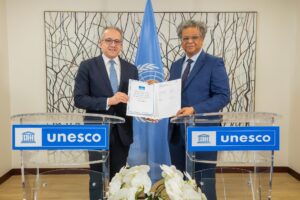
Image with Khondker M Tahla, President of the General Conference of UNESCO together with UNESCO’s Director-General, Khaled El-Enany Ezz authenticating the Recommendation on the Ethics of Neurotechnology, the world’s first global normative instrument in this field.
ETHICS – WALKING THE TIGHTROPE
Liz: One of the biggest topics about BCIs centres on ethics. What are your fears and concerns about the ethics surrounding this topic?
Rotem: Ethics is central to everything. It is a value.
If you do something wrong, if you violate ethics, if you violate trust, it has a horrifying impact not only on a patient, but on the entire field.
We are walking a path that is unpaved. We are walking a tightrope. That brings responsibility.
Ethics is not something theoretical. It is a day-to-day discussion, and it shapes day-to-day decisions for us at ABILITY Neurotech.
You can look at it from engineering, from risk management, but it is the same thing. Who comes first? That must guide your choices.
When you say, “patients are first”, that must translate into how you design, how you communicate, how you manage expectations, how you treat data, and how you behave when nobody is watching.
Liz: So practically, then what does patient involvement and ethics look like for Ability Neurotech?
Rotem: When we say we design with patients, it means we involve them all along the way.
We talk with patients, validate, assess needs, build tools with them rather than building tools and then explaining this is what they need.
We have built a Patient Advisory Board to escort us officially through the process.
Not as a slogan, or for a Pitch Deck but to ensure we think about ethics on a day-to-day basis.
And it is also about how you treat patients during the trial. Many of them already feel silent, overlooked, unimportant and forgotten.
We must maintain their trust.
Many patients told us that the direct contact person at Ability, or other BCI companies, many times a physician, is what created engagement and changed the collaboration.
Patients are not numbers.
We allocate time, resources, and intention for them. We invite them to participate. They become part of the team. Their voice is important. There is a direct one-on-one contact.
We put expectations right. We are transparent about what we do, how we do it, why we do it. What we can and cannot do. They demand and receive respect.
Liz: How do you manage those expectations, especially when the science may move slower than what a person hopes for?
Rotem: We never overpromise. We would never tell someone they will be back to who they were before the accident for example.
We talk about independence. We talk about what can be possible in a process. We align on expectations so that what we deliver is what they understand they are signing up to.
It is about being clear, transparent, and responsible in communication.
And patients always have a choice. Always.
If there is one thing, we always give patients a choice. That is part of the protocol. Of course they can stop. And yes, you plan for extraction.
That is part of ethics too.
THE PARENT RESPONSIBILITY & REGULATION
Liz: Rotem, let’s say, funding runs out for a BCI company post commercialisation or post FIH, or a company dissolves, what happens to the people who have received the implant. What duty of care do you have if any?
Rotem: When you have patients, you have responsibility. That is a major topic for the entire field, not just BCI companies.
I think the minute a company goes into humans, it must put measures in place.
Patients may be very happy with an implant, but what happens if the company that provides it dissolves?
Then what do you do?
We may be able to maintain support for a year, two years, three years, but what happens after five? What happens after ten, when the people on the project become more distant/ absent?
I have seen this happen in deep brain stimulation. Patients were implanted. They benefited, and then the company changed, got acquired, merged or in some instances was dissolved.
The field needs a better continuity plan, not only goodwill.
For ABILITY, we have a different setup. I sometimes call it a father and a mother.
We are a company, but we are backed by the Wyss Center. And by contract, if something happens to the company, the IP and the responsibilities go back to the research center. They are the parent.
I hope it stays theoretical, but it is important that this fallback exists and is communicated and contractually agreed.
Beyond us and our specific situation, I think the industry should consider whether there should be an “official body” that would step in and take care and support these patients if that ever happened, so people aren’t suddenly alone.
To be given communication is one thing. But if a patient decides to or must reverse the situation, because there is suddenly no one to maintain their well-being, that is something else.
That was what happened with Ian Burkhart, who came to see us at ABILITY to help shape our thinking.
And I don’t know what is worse – to be given communication, confidence, self-esteem and then to have to decide whether to reverse it…………… I can’t even begin to put into words what that might mean.
We need a governing body that would in the event of such situations, absorb patients, maintain knowledge. A formal process of handover, so people are not stranded.
Liz: The more you start unpicking, the more there is to reflect on. Let’s talk about the recent UNESCO & Sydney updates. What are your thoughts on this and the timing?
Rotem: We’re still at a stage where fewer than 100 people globally are living with chronic implanted BCIs.
But at the same time, 100 people is significant. That’s 100 people, their friends, their families and their ecosystem. That’s a lot of responsibility and we need to be mindful of that.
Those individuals, all of them, have put their trust in us.
The capability is accelerating quickly, driven by AI and growing investment into brain data and interfaces.
Two significant frameworks have landed in quick succession- which is promising.
The UNESCO Recommendation on the Ethics of Neurotechnology, endorsed by 194 member states in November 2025, covers mental privacy, workplace neuromonitoring, vulnerable populations, and the risks of coercive enhancement across the full lifecycle of neurotechnology
The Declaration of Sydney on the Ethical Use of AI in Neurosurgery, signed by 100+ medical leaders in February 2026, developed by a multidisciplinary group of neurosurgeons, engineers, lawyers, ethicists, and philosophers, sets out 15 shared principles covering neural data privacy, cybersecurity, and patient autonomy.
One of these is driven by governments and policymakers from the top down, the other is being built by clinicians and practitioners from the ground up.
It is happening piecemeal but directionally is right.
At Davos we have discussed this extensively also. So, this isn’t regulation reacting to scale. It’s trying to get ahead of it. It’s not enforceable. It’s a non-binding recommendation.
What it does is guide how governments, companies, and researchers should approach neurotechnology across its lifecycle.
It sets expectations rather than rules
We need to get our hands around this and formalise it, sooner than later, because there is no stopping BCIs and other areas of the brain we are exploring.
Liz: So, if it’s not binding, will it have any real impact?
Rotem: It sets the direction of travel.
It introduces concepts like treating neural data as a protected category, reinforces mental privacy and freedom of thought, and pushes for equitable access as these technologies move beyond clinical settings.
In simple terms, it’s about defining the boundaries before the field fully scales.
Liz: How should we think about the timing of this?
Rotem: Neurotechnology is being pulled into the same governance conversation that AI went through, but earlier in its lifecycle.
The installed base is still small, but the trajectory isn’t. The real question for me, is whether we’re setting the rules early enough, or just early relative to how quickly the technology is about to move.
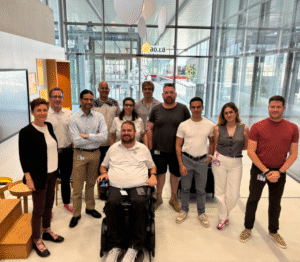
Image with Ian Burkhart and the ABILITY Neurotech Team.
DESIGNING FOR PATIENTS
Liz: That was a great insight into ethics and the related subjects. Turning to patients themselves, what are some of the most common concerns patients have about BCIs?
Rotem: When we talk about the brain, it is a black box. It is who we are. We have our personality inside, our wishes, our secrets, our future, our past.
So sometimes, when we feel something might penetrate that, it creates vulnerability and fear.
A fear of exposure. The reaction and concern for some individuals is that much stronger with BCI than if you were to suggest putting an implant somewhere else in the body, for example the back, leg or abdomen.
Safety. What if it damages another function?
Aesthetics – And of course, a further concern is, what does it look like? What will I look like? Am I going to be drawing even more attention to myself- will I look even more ‘different?’
All these points are critical for us. We are completely transparent. And we take design and discretion seriously.
When you do a design, you have many choices, and it depends on what guides you.
We know patients are sensitive about how they look so we ensure nothing is visible on the skull externally.
We know patients don’t want further surgery unless it is necessary, so we don’t place a battery inside the implant because if you need to replace a battery, it is not a simple replacement. It involves a full surgery. We do not want to impose that risk and that distress on the patient.
We had several choices between different electrodes. So, we chose electrodes which were less penetrating and less harmful for the patient but still give a signal powerful enough to provide information.
We chose surface electrodes because we did not want to risk the brain, the one organ that still works well and defines who our patients are.
So, the patient first approach has to be translated into design, into communication, into the final tool they use.
It isn’t a slide in a pitch deck.
Liz: So, coming back to ABILITY. What type of “communication system” are you aiming to restore?
Rotem: The near-term commitment is using BCI to restore speech, because that is where the need is urgent and the benefit can be profound.
And we stay grounded. A few patients doing something in a lab is not a product.
A product must be robust not only for the one patient, but robust across patients, it must be scalable and reproducible, with consistent results over time. And it must serve a real patient need, not only a scientific question.
Liz: Fred Khosravi who is one of my guests soon on Leader In The Spotlight, says, an innovation is only an innovation when it is widely adopted as the standard of care, or it is reproducible consistently across patients.
If it’s ok with you, I’d like to move the conversation to a different tangent Rotem.
THE ELON MUSK EFFECT
Liz: Valuations in BCI seem to be running ahead and there has been a funding boom in this and other parts of neurotech, more so than in others. In fact, this was part of last week’s interview with Travis Manasco Partner, at Solas Bioventures.
BCIs are very different from traditional MedTech. What would you say about the current funding situation in MedTech and NeuroTech?
Rotem: BCI used to be an acronym that only people deep in neurotech understood. Today, when you say BCI, many more people know what it means.
A big part of that is the attention Elon Musk and other big names have brought to the field. I see that as net positive.
I am not talking just about the money it has attracted to the space. Money attracts attention. Attention expands imagination.
Medtech often moves in careful increments, especially in Class III.
BCI is forcing longer-horizon thinking.
Even if valuations are running ahead of proof, the attention matters. It brings in capital, talent, and partners that wouldn’t normally engage this early, and that expands what becomes possible.
And it matters because this field has the potential to make such an impact in healthcare.
We are talking about reconnecting the brain.
And the timings associated with BCI moving into humans is different to other areas in medtech.
There is a mismatch compared to classic MedTech logic.
Many BCI companies are early, without revenue, not yet in pivotal trials, and still highly valued.
We are seeing new types of partners leaning in, large technology companies and platform players that would not typically engage with an implantable device company.
That creates opportunities beyond the standard MedTech playbook: access to capital, ecosystem pull, and alternative routes to build.
Even if pricing is ahead of fundamentals, those ecosystem effects still matter.
The work still must be proven clinically and responsibly. But the environment can accelerate what becomes possible.
Liz: Yes. You mention attracting a different type of investor. I’ve posted about some of these-companies like Apple, Microsoft, Nvidia, Google, Pharma companies, and DeepTech Investors. We also have a lot of interest from the military and state investments such as with Paradromics.
OMELETTES
Liz: But let’s turn to discuss your work with patients. What insights have you gained from this work?
Rotem: I’ve learned never to under-estimate the value of talking to the end user.
It’s easy to talk to doctors, engineers, KOLs. But when you build for patients, you should never just work off your assumptions.
I’ve realised by talking with patients that some of the things we think would be most helpful, are not what patients would prioritise.
If what we provide is not useful for the patient, how can we ask them to take the risk of working with us?
I ask myself, “How can I know what might be important to a patient who can’t communicate when I am not in their situation? Who am I to make assumptions?”
When we spoke with patients who’d been implanted with a BCI and been in trials for years, some even over a decade, we asked them, “what is it that has kept you going through these demanding trials, where we are asking you to repeat task after task after task until you are able to do something?”.
One patient told us: “for me, being completely paralyzed, to be able to hold a cup, or even do an omelette for myself, I cannot tell you how that made me feel.”
Spinal cord injury patients told us that even though they could voice command many things, it meant everyone around them could hear and was privy to everything they do.
One patient said, their mother, in the room next door, could hear everything, when they dictated a sensitive message to a friend.
They could never do anything by themselves – alone. They lost that self-independence and that self-esteem.
So, for some patients, the reason and what they want to change is deeper rooted.
They want to be seen, heard, listened to and to contribute to society.
After a severe accident, one patient said they didn’t feel useful.
They said they felt like they were not a part of society anymore. For them, participating in a trial and contributing to something that advances the field, made them suddenly feel significant.
They felt heard, part of something. “I felt listened to again. Like I could make a difference. Like I mattered.”
These patients were and are being asked their opinions. That was what mattered most for that patient.
It is in fact what matters most for a lot of the patients.
They are a very close community. Very giving. They want to be actively involved and to give hope to others and to share their stories with others.
To support and have a voice at the table for all the other people who are not there.
Those conversations keep our eyes on the right ball. Many would love some form of independence and privacy. To know they can do something alone.
SUCCESS FOR ABILITY IN 2026
Liz: We have talked about using BCI to restore communication, but there is already speculation about BCIs being used as an enhancement for healthy individuals. What are your thoughts on this and where the field goes next?
Rotem: I do not see invasive devices as a near-term path for healthy people. As an enhancement.
Invasive must start with the neediest populations because you are asking someone to take a real risk.
If you go invasive, it must be worth it for the patient to go through surgery.
Ethical and adoption constraints force a staged progression.
You start where the benefit is so significant that it clearly outweighs the risk, and then over time you can imagine other approaches, including less invasive modalities, expanding access and use cases.
Liz: If you had to describe the roadmap, what does 2026 look like for you and ABILITY NEUROTECH?
Rotem: 2026 is a transformative year. It is a shift from not only doing R&D but doing R&D and advancing.
When you go into humans which is what we are going to do, it is a huge step.
So, 2026 for us, is the jump from assessing, designing, evaluating, building correctly, into putting it into practice.
In a few weeks after you share this, we will have stepped into human data.
Human data takes different shapes and forms.
So, in a few words 2026 is about: clinical, regulatory, strategic development.
It is stepping into clinical work, walking the regulatory path, and understanding the ecosystem around us, including the partners we can work with.
Some of that is strategic, so I would say “stay tuned on specifics”, but this is the year where the work becomes real in a new way!
IT TAKES A VILLAGE
Liz: If we zoom out, what do you think we MUST get right to move forward on good footing and with trust?
Rotem: We need the village.
Elon Musk IS putting a spotlight on the field, but it must be more than that. It is not one person. It is not one company.
A lot of my excitement comes from convergence: what used to be separate fields are starting to merge. Not necessarily one single future where everyone has an implant, but multiple approaches converging, cross-pollinating, and moving faster than people expect.
If we do not hold ourselves to the highest standard with patients, ethics, and trust, the damage is not local. It hits the entire field. So, we need to build this responsibly, together.
And we need to remember why we are doing this: we are giving people a communication channel to give back independence in a way that maintains privacy, and dignity. That matters.
Liz: Rotem, thank you for such an open and grounded conversation.
What comes through clearly is that this field won’t be defined by technical milestones alone.
It will be defined by trust, and by whether people living with severe paralysis get back privacy, autonomy, and a reliable way to communicate on their own terms.
Thank you again for sharing your perspective. I’m looking forward to seeing how this next phase unfolds.
Do You Want to Be Featured?
If you are a CEO or Co-Founder and would like to be featured within my Leader In The Neurotech Spotlight, please reach out to me.
Are you a VC, FO, KOL, researcher, or clinician with a specialist interest in Neurotech – then please also get in touch, as I want to have a well-rounded perspective.
Thank you.
Understanding The Brain-The Ultimate Frontier.
About the author
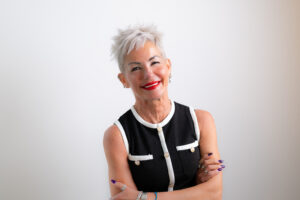
Liz is our Principal Consultant at Cruxx, covering neurotechnology markets. She is a very well liked, inisghtful, highly connected and respected, champion of start-ups and the people within them. She is unique.
Passionate and energetic, she is driven by finding the best talent today, for the healthcare technology of tomorrow.
She works globally, building impactful teams and headhunting unique talent for start-ups and VCs pushing the frontiers of medical innovation and technology.
If you are growing your team reach out. She specialises in trans-atlantic team builds, USA, Europe and wider.
From R&D, clinical and regulatory to C-suite and Board level, Liz is exceptional and relentless at sourcing visionary, talented individuals for our clients.
More to explore